300 ft arena roof truss, optimized with Claude in TrussLab
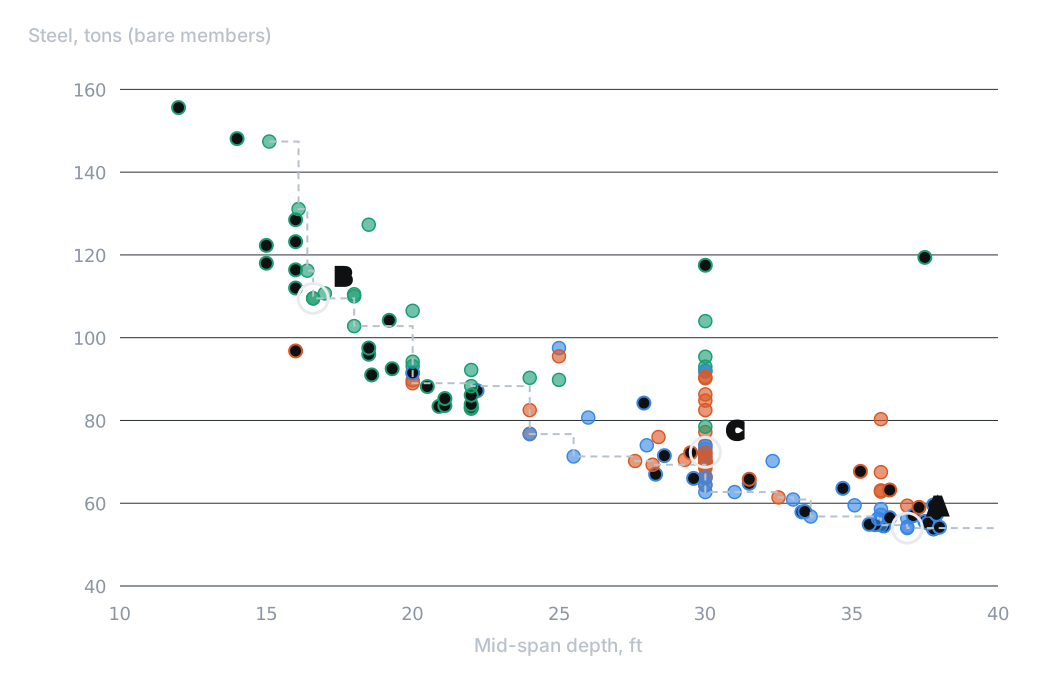
Claude, working through TrussLab, designed and optimized a 300 ft simply supported steel roof truss for an arena with a central scoreboard. More than 190 designs were analysed and auto-sized to AISC 360-22 in about one hour, and three options were shortlisted: the lightest at 54 tons, the shallowest at 16.6 ft deep, and a balanced option at 72 tons.
The brief
The brief was one written prompt. It fixed the span, loads and fabrication limits and left shape, depth, panel count and web pattern open.
| Span | 300 ft, simply supported, 30 ft tributary width |
| Dead | 20 psf |
| Snow | 40 psf, plus a half-span case added in the study |
| Roof live | 20 psf |
| Wind | 10 psf down, 30 psf uplift |
| Rigging | 10 psf, bottom chord |
| Scoreboard | 82 kip at mid-span, bottom chord |
| Code | AISC 360-22 (LRFD), ASCE 7 load combinations |
| Section families | One per option: W, round HSS or rectangular HSS |
| Bracing | Top chord every 12 ft, bottom chord at panel points |
| Fabrication | Pieces up to 40 ft, splices at least 6 ft from panel points |
| Deliverables | Steel against depth, panel count and configuration; the lightest, shallowest and best balanced options, with the reasons |
Full prompt
Design and optimize a 300 ft simply supported steel roof truss with a 30 ft tributary width in TrussLab.
Loads: dead 20 psf, snow 40 psf, roof live 20 psf, wind 10 psf downward and 30 psf uplift, rigging 10 psf, central scoreboard 82 kips.
Design exploration:
- Manually explore different truss shapes, panel counts, depths (initially L/12 to L/6, but explore beyond), diagonal arrangements, cross-diagonals, secondary bracing, and trichord and box trusses before using optimization algorithms.
- Use automatic section design as much as possible. Each option must use only one section family: W, round HSS or rectangular HSS.
- Provide top-chord lateral bracing at 12 ft intervals and bottom-chord bracing at panel points. Account for unbraced lengths when changing panel counts.
- Allow nonzero support depth if beneficial; restrain top-chord ends appropriately.
- Limit shippable member lengths to 40 ft. Keep splices at least 6 ft from panel points and consider practical fabrication.
- Design to applicable AISC 360 and ASCE 7 requirements. Check load combinations, strength, stability, member buckling, and dead, live and uplift deflections using documented serviceability limits.
Optimization workflow: first analyze and compare manually generated configurations; then optimize the most promising configurations for minimum total steel tonnage; reanalyze and verify shortlisted designs.
Deliverables: graphs of tonnage against depth, panel count and configuration; a comparison of tonnage, depth, deflection, utilization and fabrication complexity; the lightest design, the shallowest design and the best balanced option, with graphs that explain why each was chosen.
Design basis and assumptions
Where the brief left a choice open, the choice was stated before the first optimizer run.
| Item | Value |
|---|---|
| Dead, snow, roof live | On the top chord: 0.60, 1.20 and 0.60 kip/ft. Snow also checked as a half-span (unbalanced) case. No live load reduction. |
| Wind | 10 psf down and 30 psf uplift on the top chord, taken as strength level |
| Rigging | 10 psf (0.30 kip/ft) on the bottom chord, treated as live load |
| Scoreboard | 82 kip at mid-span of the bottom chord, treated as dead load and excluded from the 0.9D + W uplift case |
| Self-weight | Automatic, multiplied by 1.15 for connections, stiffeners and paint. Steel weights on this page are bare members, without the 15%. |
| Strength combinations | 1.4D; 1.2D + 1.6L + 0.5(S or Lr); 1.2D + 1.6(S, half S or Lr) + L; 1.2D + 1.6S + 0.5W; 1.2D + W + L + 0.5S; 0.9D + W |
| Deflection limits | Dead L/240; snow + rigging L/360; total L/240; 0.6 x uplift L/360; net uplift L/360. No camber credit. |
| Steel | A992 W (50 ksi); A500 Gr. C rectangular HSS (50 ksi) and round HSS (46 ksi); HSS design wall 0.93 x nominal |
| Member design | AISC 360-22 in TrussLab, webs pinned, chords continuous |
| Support | Pin and roller at the bottom chord ends; support depth studied from 0 to 18 ft |
| Sizing | Auto design, DCR band 0.70 to 0.95 (0.70 to 0.85 for reserve runs), at most 4 sections per family (3 for reserve runs) |
Not designed in this study: connections, purlins, lateral bracing members and the lateral system, seismic, ponding and site snow derivation. See limitations.
Method
- Manual study. Configurations varying shape, depth, support depth, panel count, web pattern, cross-section and section family, each auto-sized and checked.
- Optimization. The optimizer minimised tonnage for the most promising families, subject to DCR 1.0, five deflection limits and the 40 ft member length. Overall, 190+ designs were analysed and auto-sized.
- Re-analysis. Each shortlisted design was reopened and re-analysed in TrussLab, with hand checks on reactions and chord forces.
- Report. Graphs, comparison tables, assumptions and limitations were produced from the logged runs.
What the study found
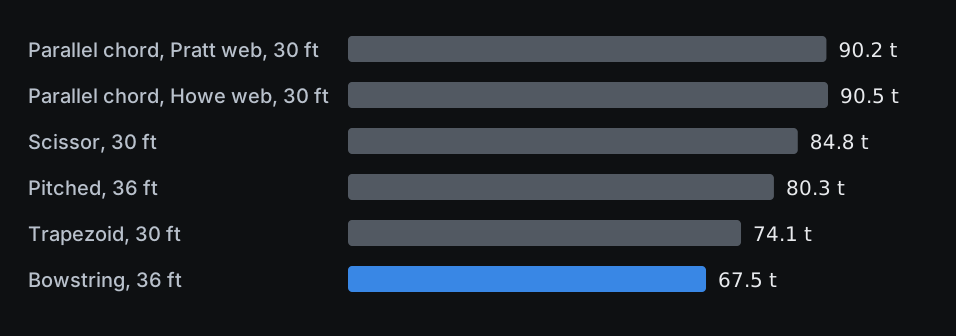
- Shape. With rectangular HSS and 20 panels, a Pratt parallel chord 30 ft deep weighed 90 tons. A scissor (30 ft deep) weighed 85 tons, a trapezoid (30 ft) 74, a pitched truss (36 ft) 80 and a bowstring (36 ft) 68.
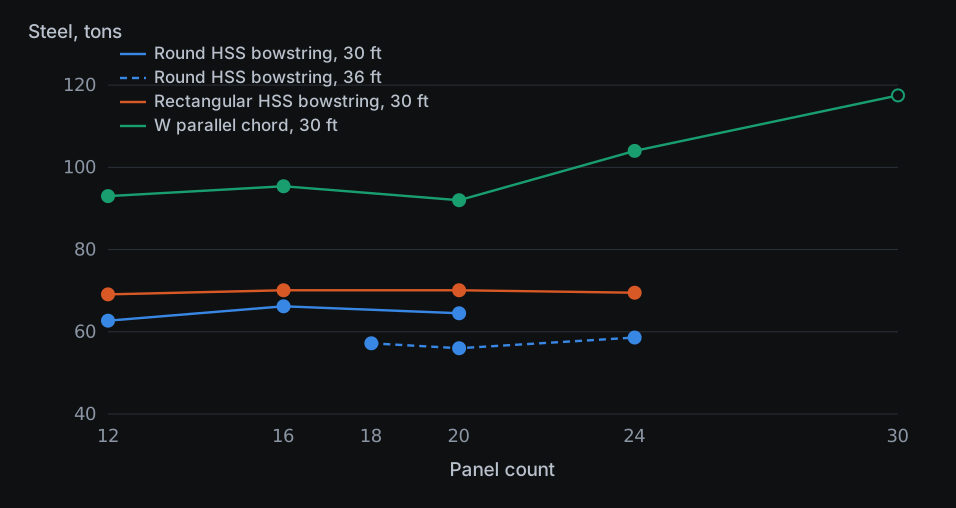
- Depth. Below about 24 ft each foot of depth costs a lot of steel, because chord forces grow and deflection governs. Deeper trusses save less. With twelve panels the 40 ft web limit is reached at about 31 ft, so more depth needs secondary members and more joints. A parallel chord truss passes the 40 ft limit above about 37 ft deep.
- Panel count. On a bowstring, panel count barely changed steel: 69 tons at twelve panels and 69 tons at twenty-four. Fewer panels remove many joints at almost no cost.
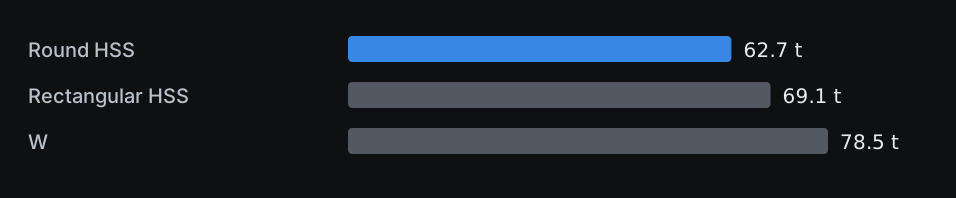
- Section family. For the same twelve-panel, 30 ft bowstring, round HSS weighed 63 tons, rectangular HSS 69 tons and W 79 tons.
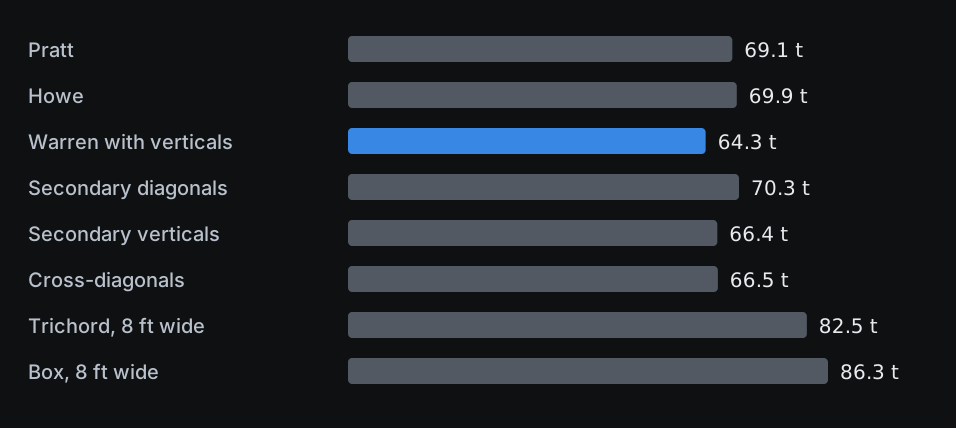
- Web pattern and cross-section. Trichord and box sections added 20 to 25% steel and many joints. The top chord is already braced, so they bring no strength benefit here.
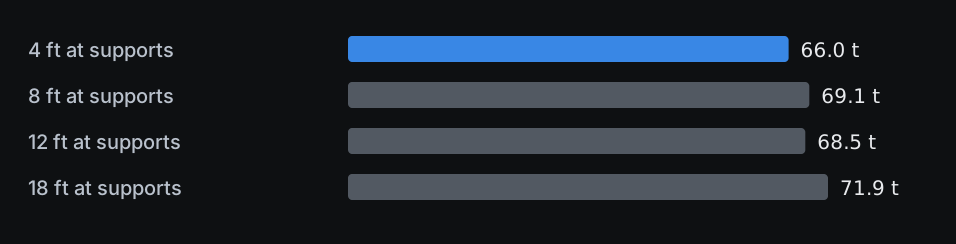
- Support depth. From 4 to 18 ft, weight varied from 66 to 72 tons, within auto-design scatter, so support depth can follow the architecture.
Three options
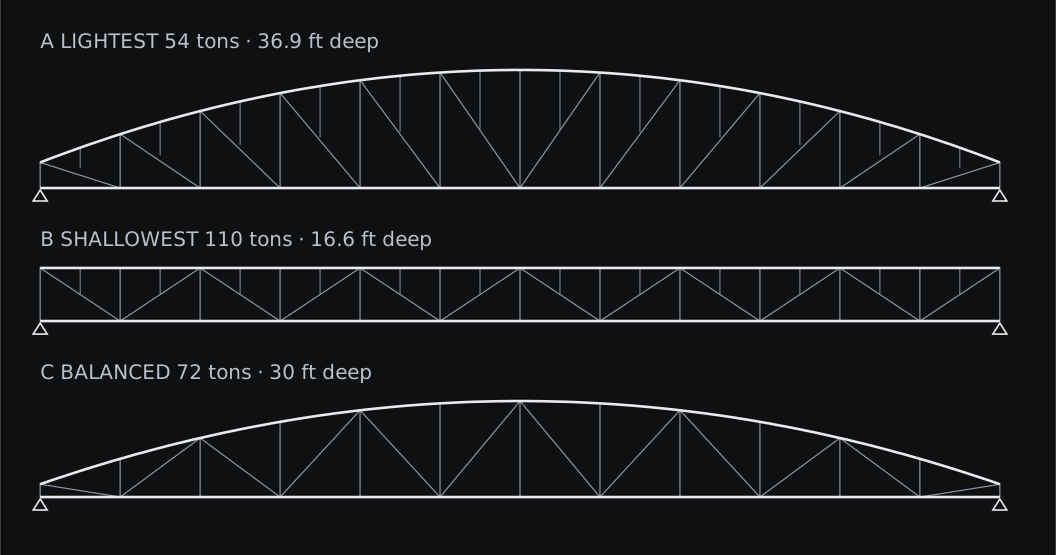
The brief asked for the lightest, the shallowest and the best balanced design. Each option has twelve panels.
| A, lightest | B, shallowest | C, balanced (recommended) | |
|---|---|---|---|
| Form | Round HSS bowstring | W parallel chord | Rectangular HSS bowstring |
| Web | Pratt + secondary verticals | Warren + secondary verticals | Warren + verticals |
| Steel, bare members | 54.0 tons | 109.5 tons | 72.3 tons |
| Steel with 15% allowance | 62.0 tons | 125.9 tons | 83.1 tons |
| Steel over A | 0% | +103% | +34% |
| Mid-span depth | 36.9 ft (L/8.1) | 16.6 ft (L/18.1) | 30 ft (L/10) |
| Support depth | 8 ft | 0 ft | 4 ft |
| Peak DCR | 0.995 | 0.940 | 0.908 |
| Peak DCR, snow +25% | 1.122 (41 members over 1) | 1.065 (10 members) | 1.017 (2 members) |
| Total deflection (limit 381 mm) | 211 mm | 346 mm | 239 mm |
| Net uplift reaction, 0.9D + W | 0.9 kip | 58.8 kip | 20.7 kip |
| Joints | 64 | 66 | 40 |
| Distinct sections | 13 | 13 | 8 |
| Top-chord splices at panel points | 5 | 0 | 5 |
A, lightest. Least steel and the deepest option. Chords and heavy webs run close to capacity, so reserve is small, and dead load only just balances wind uplift. Four long diagonals (42 to 44 ft overall) need a field splice. Secondary verticals add joints.
B, shallowest. 16.6 ft deep against 36.9 ft for A, with 103% more steel and very heavy chords. Deflection governs, and total deflection passes with little margin. A shallower truss is possible at much more steel.
C, balanced. The fewest joints and sections, flat faces for simpler web connections, a shallow eave, a clean web pattern, the lowest peak DCR and the best result when snow is raised 25%. The cost is depth and steel relative to A. A round HSS version of C weighs 71.2 tons and suits exposed round members, with more fabrication effort at the joints.
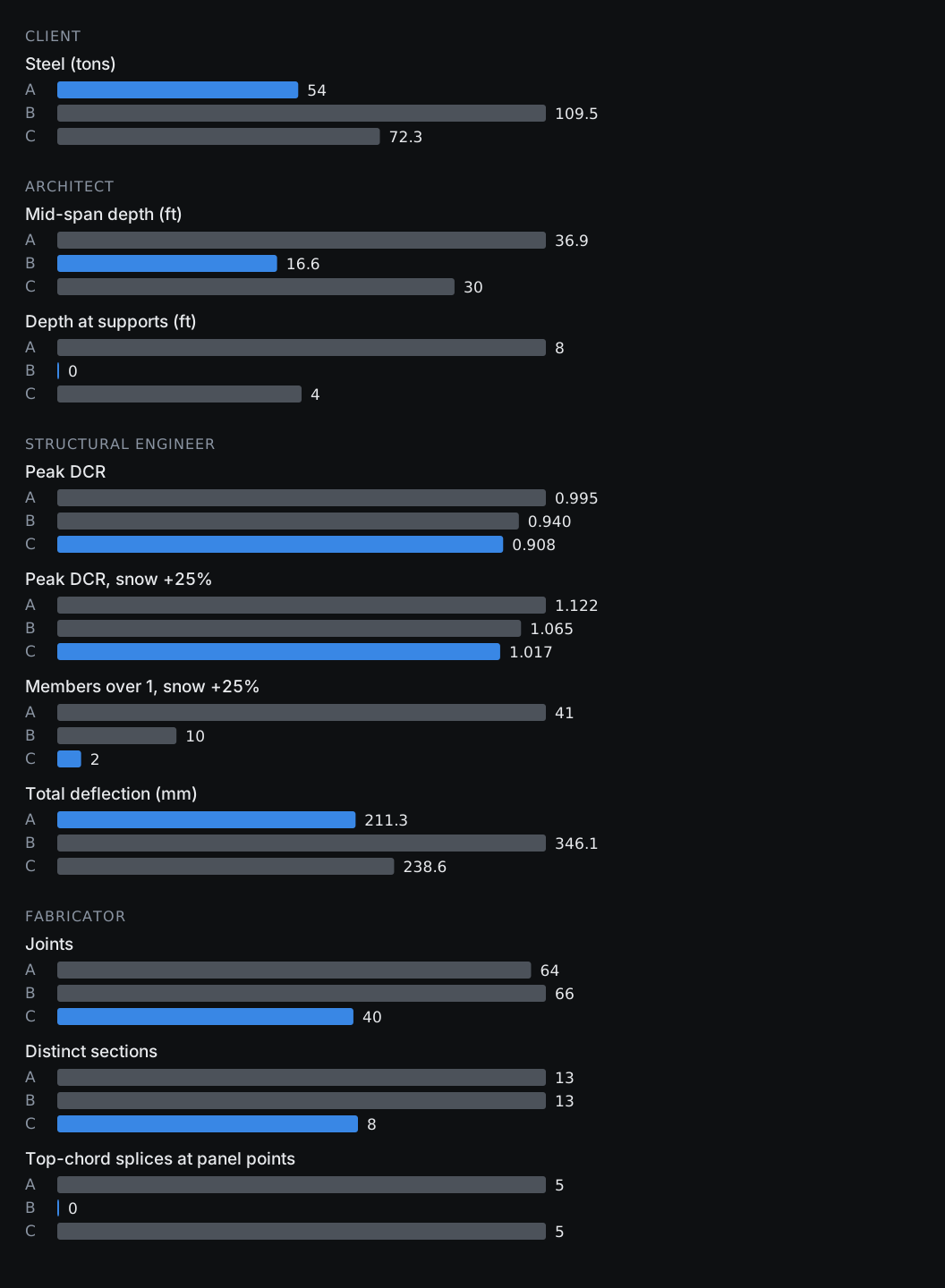
Who each option suits
| A | B | C | |
|---|---|---|---|
| Client: steel tonnage | Best | Poor | Good |
| Architect: depth | Poor | Best | Fair |
| Structural engineer | Poor | Fair | Best |
| Fabricator: joints and sections | Poor | Poor | Best |
Compliance with the brief
| Requirement | A | B | C |
|---|---|---|---|
| One section family | Round HSS only | W only | Rectangular HSS only |
| Strength, all combinations | Pass | Pass | Pass |
| Five deflection limits | Pass | Pass | Pass |
| Top bracing 12 ft; bottom at panel points | Applied | Applied | Applied |
| Chord pieces up to 40 ft | Pass | Pass | Pass |
| Web pieces up to 40 ft | 4 diagonals 42 to 44 ft overall; splice at the mid joint | Pass (30 ft) | Pass (38.5 ft) |
| Splices 6 ft from panel points | Bottom chord passes; 5 top-chord splices at panel points | Pass | Bottom chord passes; 5 top-chord splices at panel points |
| L/r up to 200 (AISC 360 E2 user note) | 217 at a mid vertical (DCR 0.14) | 228 at W10X19 verticals (DCR 0.13) | 189 at a diagonal |
| Sections from auto design | Yes | Yes | Yes, except verticals set to HSS8X8X.250 by hand |
Verification
Finalists were reopened and re-analysed. Hand checks cover global statics and sample member capacities only, not every member.
| Check | TrussLab | Hand or re-test |
|---|---|---|
| A, support reaction, 1.2D + 1.6S + L | 566 / 563 kip | 564.7 kip (wL/2 + P/2) |
| A, mid-span chord force | 1,250 kip compression | 1,248 kip (M/d) |
| B, support reaction | 641 / 642 kip | 641.3 kip |
| B, mid-span chord force | 3,160 kip compression | 3,120 kip (M/d), within 1.3% |
| C, support reaction | 590 / 590 kip | 590.0 kip |
| C, mid-span chord force | 1,600 kip compression | 1,598 kip (M/d) |
| W14X176 chord compression ratio | 0.818 | 0.82 (1,650 / 2,010 kip, AISC 360 E3) |
| Saved options reopened and re-run | Same weight, DCR and deflection | Same result |
Limitations
This is a concept study, not an issued design. The items below need the engineer of record's attention before use.
- Connections. No joints, gussets, HSS chapter K checks or chord plastification were designed. The 15% allowance is not a connection design, and thin webs on thick HSS chords may be governed by the joint.
- Bracing and stability. Purlins, bottom-chord ties, the lateral system and erection stability are assumed, not sized, and are not in the steel weight.
- Top-chord splices. All three finalists on curved or bowstring chords show 5 top-chord splices at panel points. They need to move at least 6 ft in detailing, with the 40 ft limit re-checked.
- Long diagonals on A. The optimizer length limit reads each segment, so a diagonal split by a secondary vertical can pass while its full length exceeds 40 ft. Four diagonals on option A need a field splice.
- Loads not supplied. No seismic, lateral wind, ponding, site snow derivation or scoreboard dynamics. A reduced combination set was used.
- Sections. Auto design used the full catalogue, including large HSS sizes, and availability was not checked. Sizing is not mirrored, so short odd end pieces appear and should be rationalised, at a small weight increase.