
80 m span steel truss: optimization case study
Five configurations of an 80 m span steel truss were designed in TrussLab with the same loads and supports and compared on steel weight and governing utilization. All five pass every member check. The optimized truss weighs 24.67 t.
Results
| Configuration | Mid-span depth (m) | Weight (t) | Max DCR |
|---|---|---|---|
| Optimized: parabolic top, trapezoidal bottom, 17 panels | 7.67 | 24.67 | 0.956 |
| Bowstring, 16 panels | 6.5 | 28.92 | 0.936 |
| Bowstring, 16 panels | 7.0 | 29.07 | 0.884 |
| Pratt, 16 panels | 7.0 | 30.97 | 0.992 |
| Bowstring, 16 panels | 5.0 | 33.99 | 0.980 |
The optimized truss is 4.25 t (14.7 %) lighter than the best bowstring case and 6.30 t (20.3 %) lighter than the Pratt case.
Optimized truss
Span 80 m, 17 panels, parabolic top chord and trapezoidal bottom chord, 7.67 m deep at mid span (L/10.4). Top chord W21X101, bottom chord W21X83, web members W6X8.5. The governing member is top chord #0 under combined forces, at DCR 0.956.

Pratt baseline
Span 80 m, 16 panels, trapezoidal top chord and flat bottom chord, 7.0 m deep at mid span (L/11.4). The governing member is bottom chord #19 (W16X45) under combined forces, at DCR 0.992.
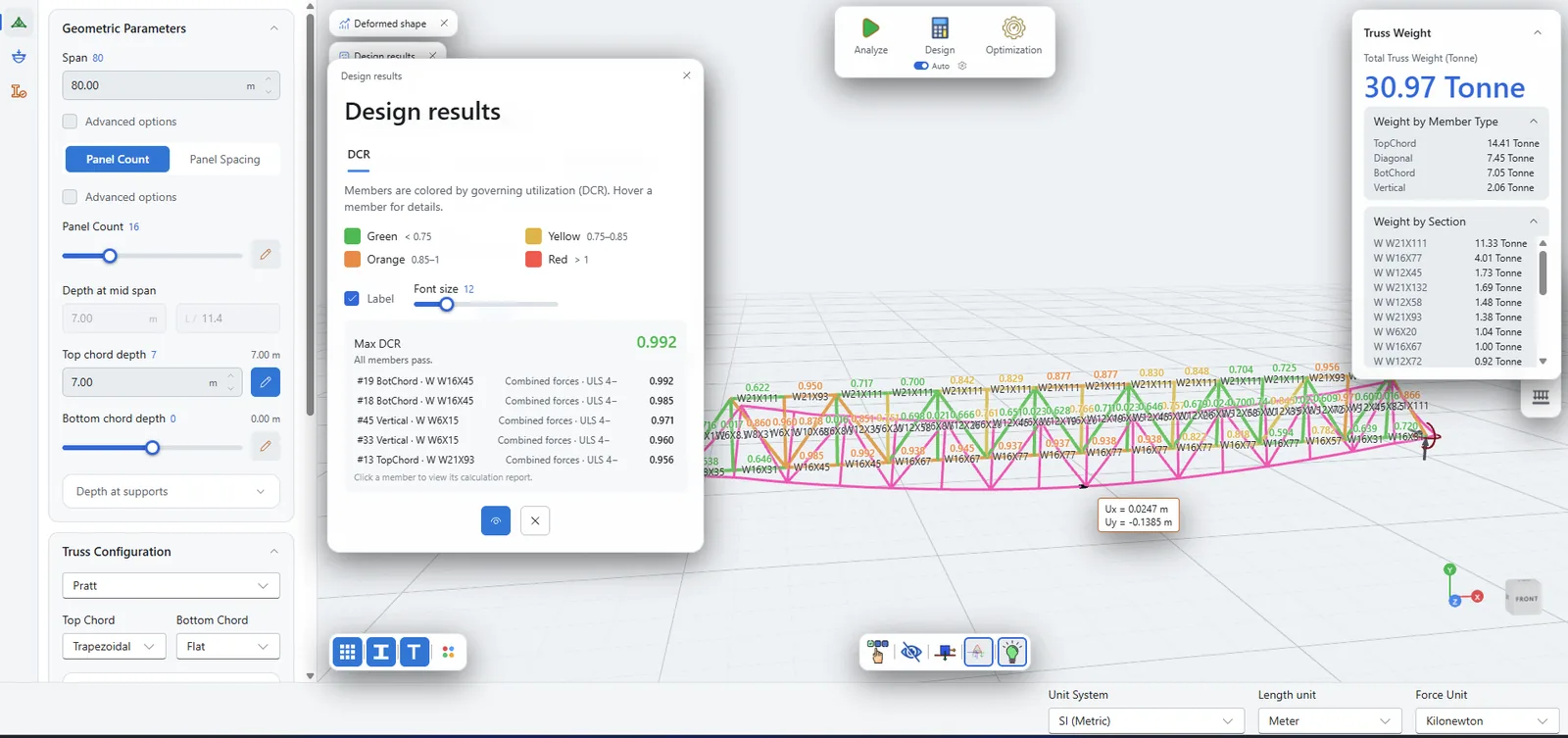
Weight by member type
| Member type | Optimized (t) | Pratt (t) |
|---|---|---|
| Top chord | 12.31 | 14.41 |
| Bottom chord | 9.88 | 7.05 |
| Diagonals | 1.37 | 7.45 |
| Verticals | 1.10 | 2.06 |
| Total | 24.67 | 30.97 |
Observations
- The web carries most of the difference. The Pratt truss puts 9.5 t into diagonals and verticals; the bowstring cases, with light W6X8.5 web members, put 2.0 to 2.2 t, and the optimized truss 2.5 t.
- Depth does not reduce weight monotonically. The bowstring at 6.5 m (28.92 t) is lighter than the one at 7.0 m (29.07 t), since chord sections change in catalogue steps.
- The optimizer moved beyond the depths and panel counts of the manual cases: a deeper truss (7.67 m) with one more panel and a different chord shape combination than any of the four manual layouts.
Optimization run
The run was set to 1000 iterations and stopped at iteration 729 on stagnation, then applied the best result found. Method and settings: truss optimization.