
Truss optimization: geometry, topology and section sizes
TrussLab searches truss geometry, topology and member sizes in one run. Every candidate is analyzed and checked to the selected design code, and the results are ranked by steel weight, utilization and deflection.
Design variables
- Shape: top and bottom chord depth, depth at the supports, span, panel count and panel spacing.
- Type: truss type and chord shape.
- Topology: presence and orientation of diagonals, verticals and cross (X) bracing, including the number of X-braced end panels.
- Sizing: section per member group, searched across shape families (for the AISC catalogue W, M, S, HP, C, MC, L, WT, MT, ST, HSS rectangular, HSS round and Pipe).
Objective
The cost function weights total steel tonnage, the deviation from a target demand-capacity ratio, and deflection, with deflection penalized asymmetrically. Optional penalties count connections, unique sections and physical pieces, so a lighter design with many different sections can be traded against a simpler one to fabricate.
Algorithm and run control
The search uses a genetic algorithm with configurable settings. A run stops at the iteration limit or earlier when the best result stagnates, and a live 3D view shows the current design during the run. The best result is applied to the model, where it can be checked and edited like any other truss.
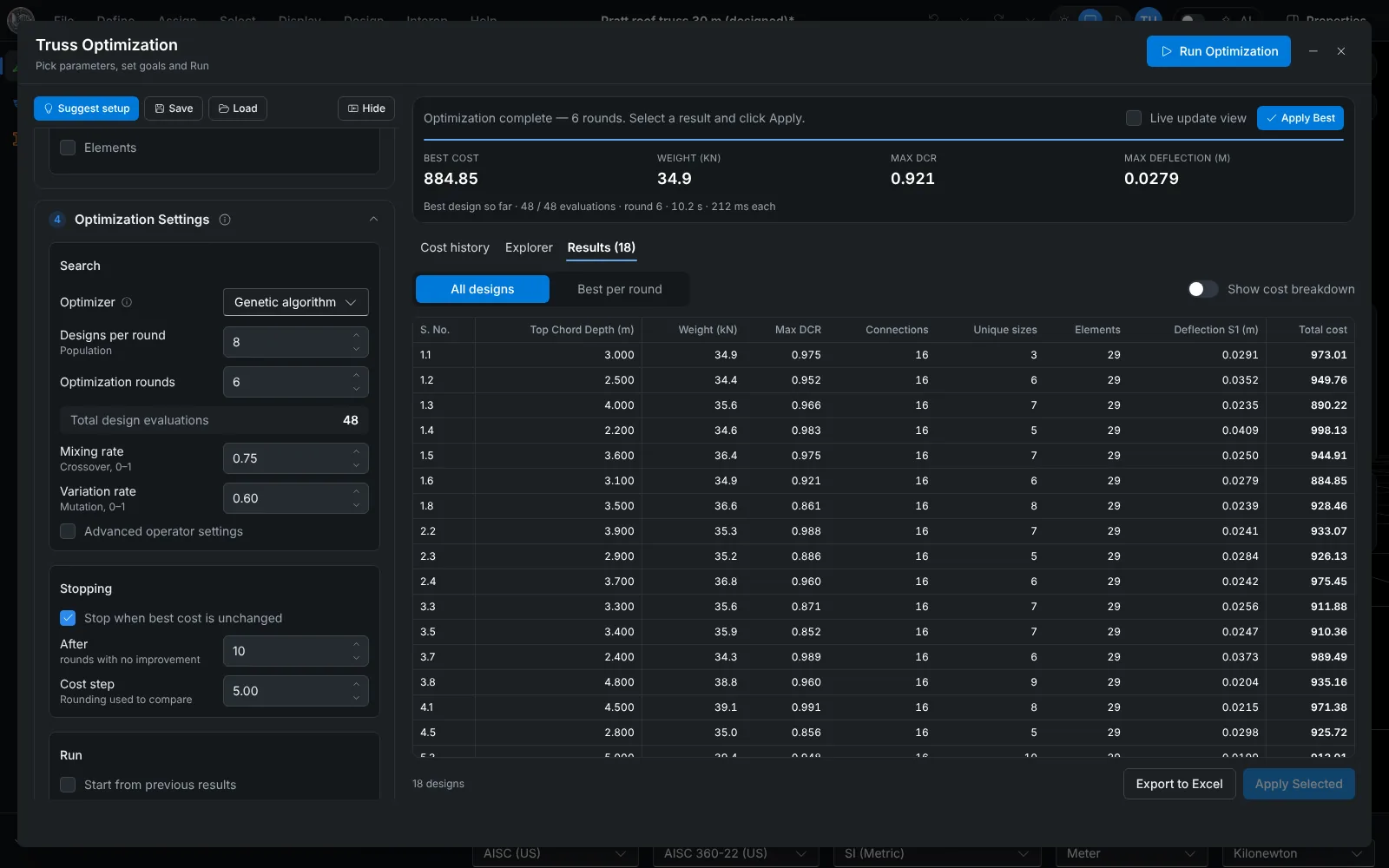
Results can be exported to Excel for comparison.
Example: 80 m span
Five configurations of an 80 m span truss were compared, all passing every member check. The optimized truss (17 panels, parabolic top chord, trapezoidal bottom chord, 7.67 m deep at mid span) weighs 24.67 t: 14.7 % less than the best bowstring layout (28.92 t) and 20.3 % less than a Pratt layout (30.97 t).

Full results: 80 m span truss case study.
Where the savings come from
- Depth: chord forces fall with depth while web members lengthen; the optimum depends on the section steps available in the catalogue, not only on the span-to-depth ratio.
- Chord shape: a curved top chord follows the bending moment diagram, so the chords carry most of the load and the web forces stay small.
- Web layout: in the 80 m example the Pratt truss puts 9.5 t into diagonals and verticals, against 2.5 t in the optimized truss.
- Section grouping: the unique-section and piece-count penalties keep the result practical to fabricate.
Frequently asked questions
Which optimization algorithm is used?
A genetic algorithm with configurable settings and stagnation-based early termination. Geometry, topology and member sizes are searched together.
Are the optimized designs code-checked?
Yes. Every candidate is analyzed and its members are checked to the project design code (AISC 360-22, EN 1993-1-1, AS 4100:2020 or IS 800:2007). Utilization enters the cost function through the target demand-capacity ratio.
Is this topology optimization?
It is a discrete layout optimization of truss topology: the presence and orientation of diagonals, verticals and cross bracing are design variables, together with shape and section sizes. It does not produce free-form ground-structure layouts.