
Parametric truss design
In TrussLab a truss is defined by parameters, not by drawing nodes and members. Span, depth, panel count, truss type and chord shapes generate a connected truss with consistent joints, and the analysis and member checks follow every change.
Geometric parameters
- Span, and panel count or panel spacing.
- Depth at mid span, top chord depth, bottom chord depth and depth at the supports. The span-to-depth ratio is shown with the depth.
- Chord shapes: parabolic, pitched, trapezoidal or flat, set for the top and bottom chord independently.
- Web layout: diagonal direction, verticals, and cross (X) diagonals over a set number of end panels.
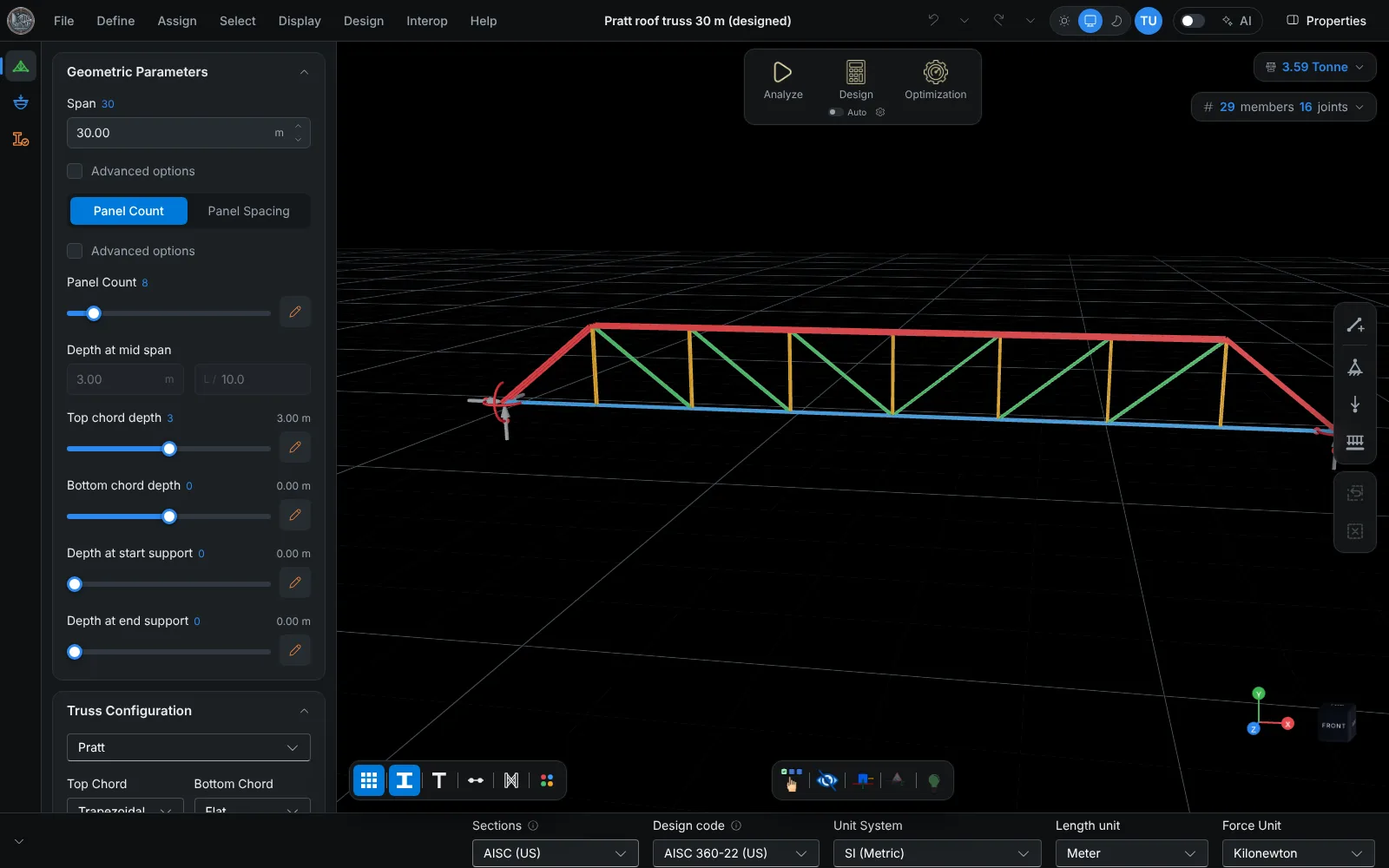
Truss types
Each type is a preset of the same parameters and can be adjusted after selection.
| Type | Geometry |
|---|---|
| Pratt | Parallel or shaped chords; diagonals slope down toward mid span, so they are in tension under gravity load. |
| Howe | Diagonals slope the other way from Pratt, so they are in compression under gravity load. |
| Warren | Diagonals alternate in direction, with or without verticals. |
| Parallel chord | Top and bottom chords parallel; used for floors, long roof spans and bridges. |
| Pitched | Sloping top chord to a ridge; the common roof truss. |
| Bowstring | Curved top chord over a straight bottom chord. |
| Barrel | Curved top and bottom chords, for barrel-vaulted roofs. |
| Tapered | Depth varying along the span, as for mono-pitch roofs. |
| Scissor | Sloping bottom chord below a pitched top chord, for vaulted ceilings. |
Pratt, Howe and Warren share one chord layout and differ in the direction of the diagonals, so switching between them compares web layouts on the same chords.
What follows a parameter change
- Nodes and members are regenerated with consistent joints.
- Supports (fixed, pinned, roller or custom restraints) are remapped to the new geometry.
- The analysis and the member checks run again on the new geometry.
- Members drawn by hand with the Add Member tool are removed, since they are tied to the previous nodes.
Parameters as design variables
The same parameters are the design variables of the optimizer: depth, span, panel count and spacing, truss type, chord shapes, the presence of diagonals, verticals and cross bracing, and the section of each member group. A layout study that would otherwise need each variant remodeled runs as one optimization.
Trusses on a roof surface
A truss can be linked to a roof imported from DXF in the roof workspace. Its top chord is then projected to the roof section along the span, and copies of the truss are arrayed along the roof. Details: steel roof truss design.
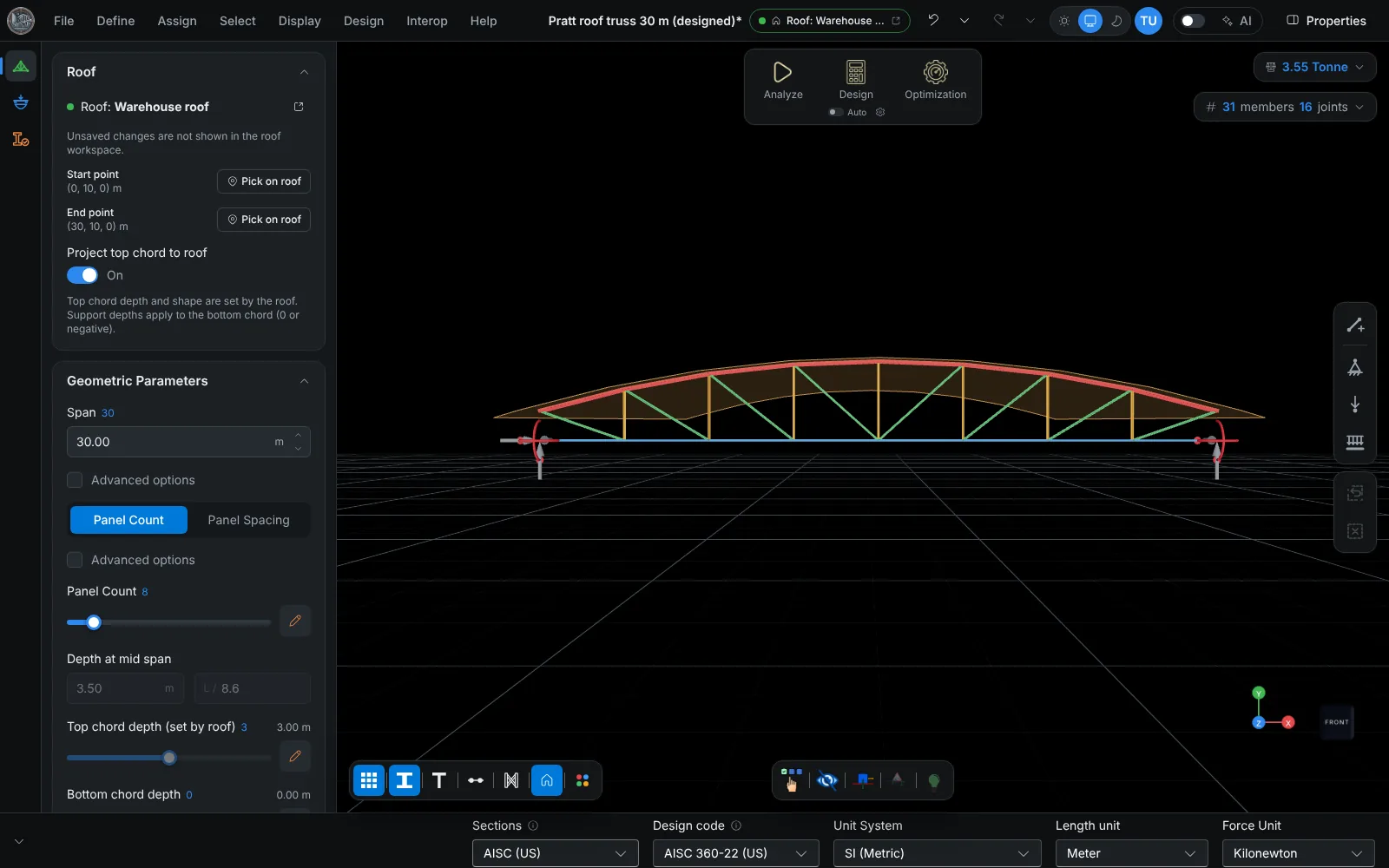
Scripted and AI-driven modeling
AI assistants (Claude, ChatGPT, Cursor, VS Code) set the parameters through TrussLab's MCP server, for example: "Model a 24 m Pratt roof truss with 8 panels and 2 m depth, pinned and roller supports, and 9 kN/m dead and 6 kN/m roof live load on the top chord. Auto-design it and report tonnage and the maximum DCR." Each change appears live in the open browser tab.
Frequently asked questions
Which truss types can be generated?
Pratt, Howe, Warren, Parallel chord, Pitched, Bowstring, Barrel, Tapered and Scissor, with independent top and bottom chord shapes.
Can members be added by hand?
Yes. The Add Member tool snaps new members to existing nodes. Hand-drawn members are removed when the parametric geometry is changed afterwards.
Is lateral bracing modeled?
Chord bracing is defined as unbraced lengths (at panel points, at panel and mid points, or at a custom spacing) and used in the buckling checks. The bracing members themselves are not modeled.