
AS 4100 truss design
TrussLab checks every truss member to AS 4100:2020 for each strength combination, with Australian sections (UB, UC, PFC, angles, SHS, RHS and CHS) and a step-by-step calculation report per member.
Limit states checked to AS 4100:2020
Every truss member is checked for each strength load combination. The governing combination and limit state are reported per member as a demand-capacity ratio (DCR), and members are colored by DCR in the model view.
| Limit state | AS 4100:2020 clauses |
|---|---|
| Tension | 7.2 |
| Compression | 6.2, 6.3.3 |
| Bending | 5.2, 5.6.1.1, 5.6.1.2 |
| Shear | 5.11 |
| Combined actions | 8.3.4, 8.4.5 |
Capacity factor φ = 0.9. Each plate element takes the yield stress of its own thickness band (AS/NZS 3679.1) for its slenderness; section and member capacities use the design yield stress of the section. The member checks of Clause 8.4.5 are reported as a load factor.
Sections and steels
Australian catalogue (AS/NZS 3679.1, AS/NZS 1163): UB, UC, PFC, EA, UA, double angle, SHS, RHS and CHS. Steels: 300 and 350 (AS/NZS 3679.1); C250, C350 and C450 (AS/NZS 1163). Hollow sections rolled only in a lower grade are designed in that grade.
Members are grouped (top chord, bottom chord, diagonals, verticals), each group is assigned a catalogue section and one of the standard steels, and individual members can be overridden. Auto-design selects sections that pass the checks; the optimizer also varies geometry and topology.
Calculation report
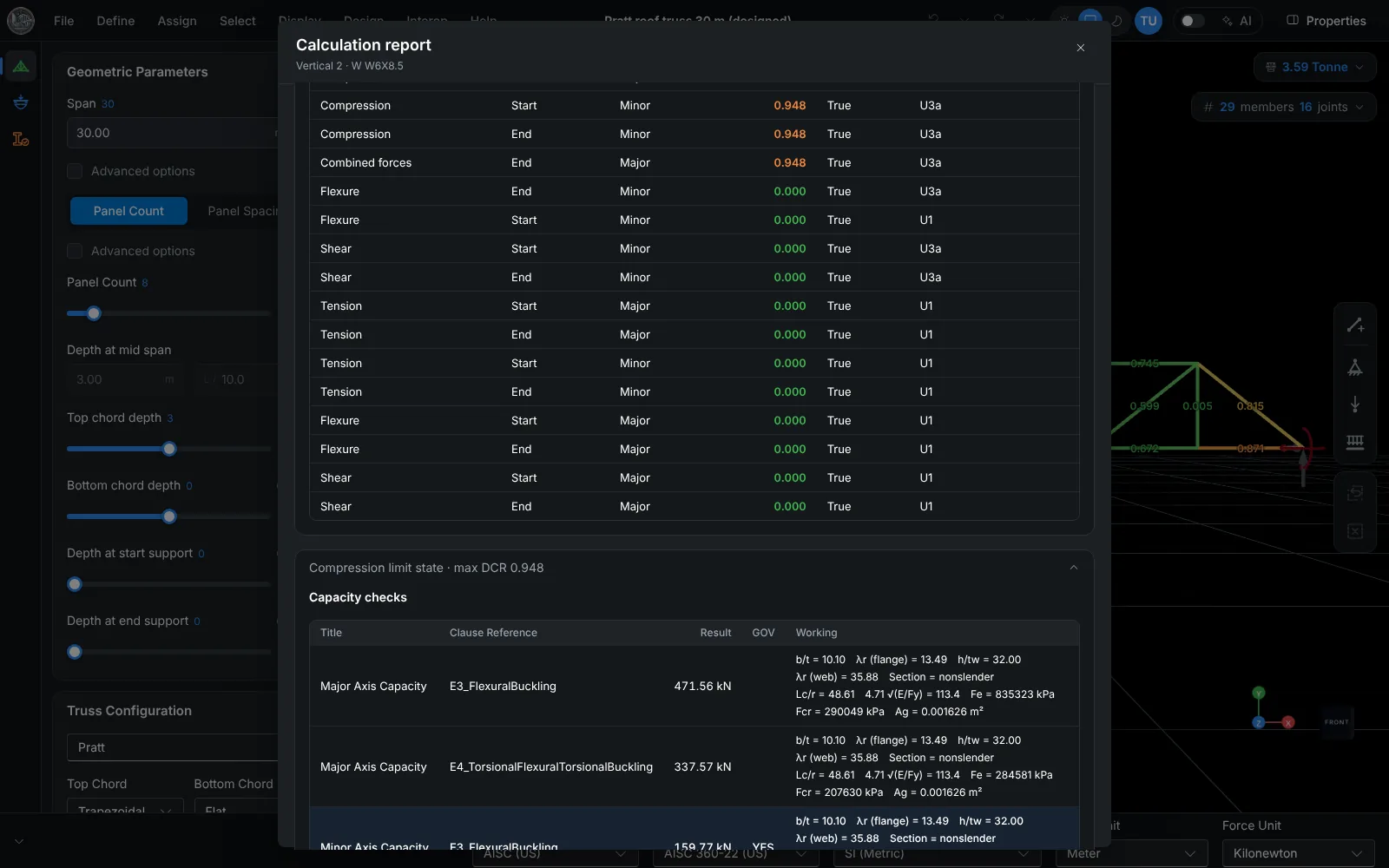
A step-by-step calculation report is generated for each member, per limit state and governing load combination, with the demand, the design strength and the resulting DCR. The full truss report is exported as PDF.
Verification against published AS 4100:2020 examples
Capacities are compared with the Australian Steel Institute's Sample Worked Problems to AS 4100, the Steel Designers' Handbook (Gorenc, Tinyou & Syam), Kirke & Al-Jamel's Steel Structures Design Manual to AS 4100, and the AS 4100 verification problems of STAAD.Pro.
The inputs, reference values, TrussLab values and differences are listed on the verification page, with downloadable project files.
Scope and differences from the code examples
- The moment modification factor αm = 1.0 is used for every member.
- Tension fracture uses An = Ag and kt = 1.0, since connections are not modelled.
- The higher reduced section capacities of Clause 8.3.2 for compact doubly symmetric I-sections are not used.
- Analysis is linear elastic and static. Connections are not designed.
Frequently asked questions
Is AS/NZS 4600 (cold-formed) supported?
No. Members are designed to AS 4100:2020. Cold-formed hollow sections to AS/NZS 1163 are designed to AS 4100.
Can the design code be changed after the model is built?
Yes. The design code is a project setting. Selecting another code re-runs the member checks and sets that code's default load combinations; the geometry and loads are kept. Any code can be used with any section catalogue.
Are connections designed?
No. TrussLab designs members only. A selected joint with its connected members and forces is exported to IDEA StatiCa Connection for connection design.